
Speed vs. Safety: How Marketing Teams Stay Compliant at Scale
How three global marketing leaders are scaling output without scaling risk
Speed vs. Safety: How Marketing Teams Stay Compliant at Scale
How three global marketing leaders are scaling output without scaling risk
Contents
8 mins
Contents
8 mins
Introduction: You're Scaling Output. Is Your Governance Keeping Up?
Your marketing team is faster than it's ever been. Your approval process isn't. AI made high-volume content achievable, but it didn't update the governance frameworks and review infrastructure that needed to scale alongside it.
We call the gap between those two things compliance debt. It accrues each time content is created faster than it can be properly reviewed. It builds slowly, and it builds invisibly. Instead, you feel it when something fails publicly.
In regulated industries, the consequences are real. A missed disclosure, a greenwashing claim replicated across fifty localized variants, a brand voice that's drifted so far from its guidelines that it becomes unrecognizable – this is what compliance debt looks like when it finally catches up with you.
The good news is that the teams solving this aren't doing it by slowing down. They're building smarter systems. This report draws on conversations with senior marketing leaders in regulated industries including financial services, technology, and logistics to show you what those systems look like in practice.
Introduction: You're Scaling Output. Is Your Governance Keeping Up?
Your marketing team is faster than it's ever been. Your approval process isn't. AI made high-volume content achievable, but it didn't update the governance frameworks and review infrastructure that needed to scale alongside it.
We call the gap between those two things compliance debt. It accrues each time content is created faster than it can be properly reviewed. It builds slowly, and it builds invisibly. Instead, you feel it when something fails publicly.
In regulated industries, the consequences are real. A missed disclosure, a greenwashing claim replicated across fifty localized variants, a brand voice that's drifted so far from its guidelines that it becomes unrecognizable – this is what compliance debt looks like when it finally catches up with you.
The good news is that the teams solving this aren't doing it by slowing down. They're building smarter systems. This report draws on conversations with senior marketing leaders in regulated industries including financial services, technology, and logistics to show you what those systems look like in practice.
Section 1
Section 1
The New Reality: More Output, Less Resource
Your job has changed fast. Stakeholder expectations around content volume and speed shot up at exactly the moment team sizes got reduced. New channels, always-on campaign cycles, leadership seeing what AI could do elsewhere and wondering why you weren't doing it too. If you're in a global brand, that pressure multiplies across every market you operate in.
The teams keeping pace are doing it by redesigning how work gets done. There's no version of working harder that closes this gap, and nobody knows that better than a global logistics brand producing content across 220 countries:
"Expectations around speed have increased dramatically, while team sizes largely haven’t…. For many marketers, stakeholders now expect content to be turned around instantly, and localized. Speed isn’t about working harder – it’s about working smarter."

Lee Nelson
VP Global Marketing and Communications, DHL
"Expectations around speed have increased dramatically, while team sizes largely haven’t…. For many marketers, stakeholders now expect content to be turned around instantly, and localized. Speed isn’t about working harder – it’s about working smarter."

Lee Nelson
VP Global Marketing and Communications, DHL
The competitive stakes of not meeting output and speed expectations are real, and for leaders who've lived through the shift firsthand, the risk isn't abstract:
"If you can't keep pace with AI - you will probably lose your position in the market. There will be competitors or new brands that come in and take your customers because they are able to offer them what they need, because they’ll understand their needs more deeply and deliver exactly what they want, at the moments that matter most."

Silvia Dominguez
Customer & Marketing Executive, former Optus
"If you can't keep pace with AI - you will probably lose your position in the market. There will be competitors or new brands that come in and take your customers because they are able to offer them what they need, because they’ll understand their needs more deeply and deliver exactly what they want, at the moments that matter most."

Silvia Dominguez
Customer & Marketing Executive, former Optus
The point is blunt but worth sitting with. Scaling your marketing output is no longer just a competitive advantage, it's table stakes.
AI Has Removed Your Production Bottleneck and Created a Governance One
AI came into most marketing workflows as a production tool: faster copy drafts, cheaper localization, quicker iteration. And it delivered. Tasks that once took hours now take minutes, and content that once required specialist resources can be carried out by generalist teams.
But solving the production problem created a new one. When a small team can suddenly produce what a much larger team used to, the review and approval infrastructure doesn't scale to match. Output grows. Governance doesn't. The gap between them is where compliance debt starts to build.

Section 2
Section 2
So What Are You Actually Risking?
AI scaling your output is the easy part. What scales with it, if you're not careful, is your exposure. More content means more compliance touchpoints, more chances for brand drift, and more pressure on a manual review process that was never designed for this volume. Most teams don't feel it building. They feel it when something goes wrong.
The Regulatory Risk: More Content, More Exposure
Every piece of AI-generated content that goes out without adequate review is a small withdrawal from a trust account that takes years to build. In regulated industries, where the rules around accuracy, disclosures, and regional compliance are non-negotiable, that exposure adds up fast.
So What Are You Actually Risking?
AI scaling your output is the easy part. What scales with it, if you're not careful, is your exposure. More content means more compliance touchpoints, more chances for brand drift, and more pressure on a manual review process that was never designed for this volume. Most teams don't feel it building. They feel it when something goes wrong.
The Regulatory Risk: More Content, More Exposure
Every piece of AI-generated content that goes out without adequate review is a small withdrawal from a trust account that takes years to build. In regulated industries, where the rules around accuracy, disclosures, and regional compliance are non-negotiable, that exposure adds up fast.
"In regulated industries, like financial services or healthcare, trust is the currency. A single misleading claim – even unintentionally generated – can damage years of brand equity. The problem with using AI in marketing isn’t that it makes mistakes. It’s that without the right tools and guardrails in place, those mistakes get published at scale."

Chloe Stevens
Marketing Lead, Haast
Think about what compliance actually means for a single piece of content. One social post touches advertising standards, consumer protection law, greenwashing regulations, brand tone, localization requirements, and that's before channel-specific rules come into it. The compliance obligation per asset has always been significant, but what's new is the volume. Content output at some of the world's largest brands has increased by as much as 400% in the last year, and the infrastructure underneath it hasn't kept pace. That gap is where the exposure lives.
"AI can produce content that looks credible but is slightly wrong. In a logistics business, accuracy really matters. AI doesn’t always understand which details are mission-critical and which are optional."

Lee Nelson
VP Global Marketing and Communications, DHL
"AI can produce content that looks credible but is slightly wrong. In a logistics business, accuracy really matters. AI doesn’t always understand which details are mission-critical and which are optional."

Lee Nelson
VP Global Marketing and Communications, DHL
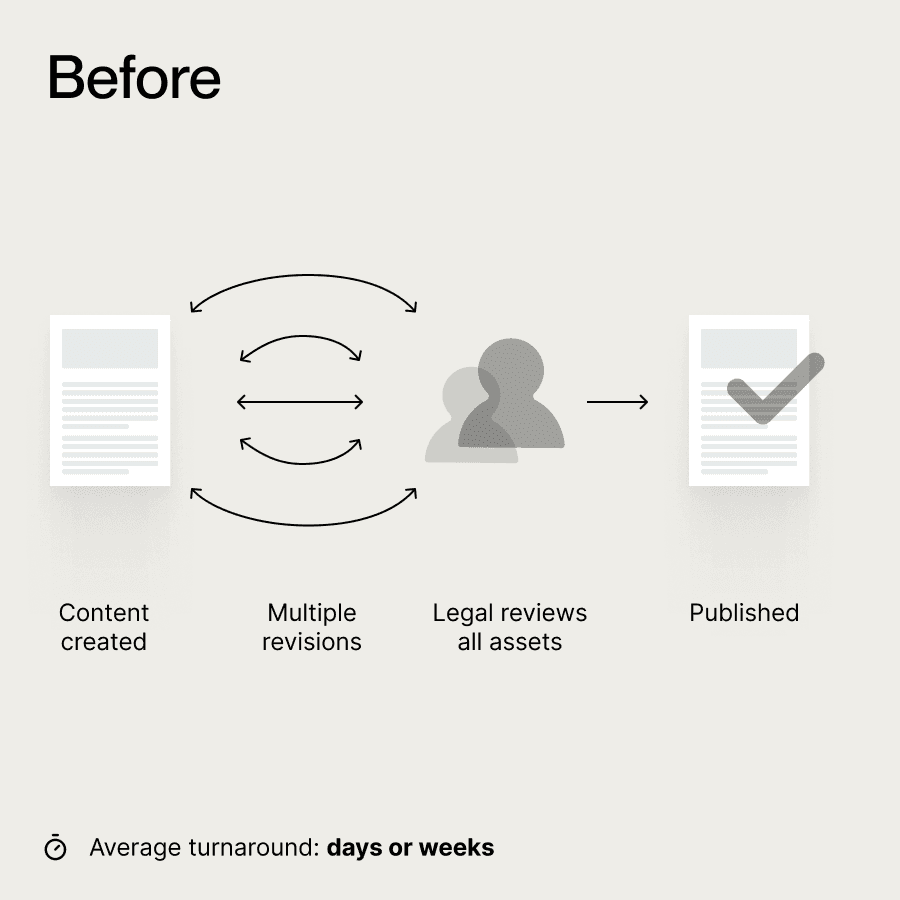
One misworded claim in a single published asset can cost a business millions and take years to recover from in terms of brand trust. Scale that across fifty localized variants, five channels, and multiple jurisdictions, and the damage is extremely difficult to walk back from.
Your Legal Team Isn't the Problem. Your Process Is.
Without a structural fix, you're left choosing between slowing down or accepting more risk. Neither is a real answer.
One misworded claim in a single published asset can cost a business millions and take years to recover from in terms of brand trust. Scale that across fifty localized variants, five channels, and multiple jurisdictions, and the damage is extremely difficult to walk back from.
Your Legal Team Isn't the Problem. Your Process Is.
Without a structural fix, you're left choosing between slowing down or accepting more risk. Neither is a real answer.



The Brand Risk: Inconsistency, Not Ambition
Bold ideas rarely break a brand, inconsistency does. When your teams are generating content independently using different tools, different prompts, and different readings of your brand guidelines, output starts to drift. Each individual asset might pass review. But tone shifts slightly here, messaging goes off-register there, and over time your brand starts to sound different to itself across channels.
The Brand Risk: Inconsistency, Not Ambition
Bold ideas rarely break a brand, inconsistency does. When your teams are generating content independently using different tools, different prompts, and different readings of your brand guidelines, output starts to drift. Each individual asset might pass review. But tone shifts slightly here, messaging goes off-register there, and over time your brand starts to sound different to itself across channels.
"If people use different prompts or approaches, brand voice can drift very quickly. Quality becomes uneven. The more content you produce, the more disciplined you need to be on the fundamentals: story, tone, and brand coherence."

Lee Nelson
VP Global Marketing and Communications, DHL
"If people use different prompts or approaches, brand voice can drift very quickly. Quality becomes uneven. The more content you produce, the more disciplined you need to be on the fundamentals: story, tone, and brand coherence."

Lee Nelson
VP Global Marketing and Communications, DHL
That fragmentation is subtle but cumulative. And in regulated industries where your customers are making real decisions about their money, their health, their future, inconsistency doesn't just weaken your brand, it undermines the trust you've spent years building.
We're also in a moment where that trust is harder to earn than ever. The volume of AI-generated content in the market has increased faster than consumers' ability to filter it. Most of it sounds the same: competent, frictionless, and completely interchangeable. In that environment, brands that sound consistently and recognizably themselves stand out not just for aesthetic reasons, but commercial ones.
In regulated industries especially, where the relationship with your customer is built on credibility over time, consistency isn't just good brand hygiene. It's how you stay competitive.
That fragmentation is subtle but cumulative. And in regulated industries where your customers are making real decisions about their money, their health, their future, inconsistency doesn't just weaken your brand, it undermines the trust you've spent years building.
We're also in a moment where that trust is harder to earn than ever. The volume of AI-generated content in the market has increased faster than consumers' ability to filter it. Most of it sounds the same: competent, frictionless, and completely interchangeable. In that environment, brands that sound consistently and recognizably themselves stand out not just for aesthetic reasons, but commercial ones.
In regulated industries especially, where the relationship with your customer is built on credibility over time, consistency isn't just good brand hygiene. It's how you stay competitive.
Section 3
Section 3
When the Volume Outpaces Manual Review, You Need Technology
At the scale AI makes possible, manual governance isn't just inefficient. It's insufficient. The volume of content marketing teams are now producing cannot be reviewed, checked, and approved through human effort alone without either creating a bottleneck that kills your speed or thinning the review to the point it stops meaning anything. In regulated industries, both of those outcomes carry real consequences. Technology isn't a nice-to-have at this scale. It's the only way to make compliance work.
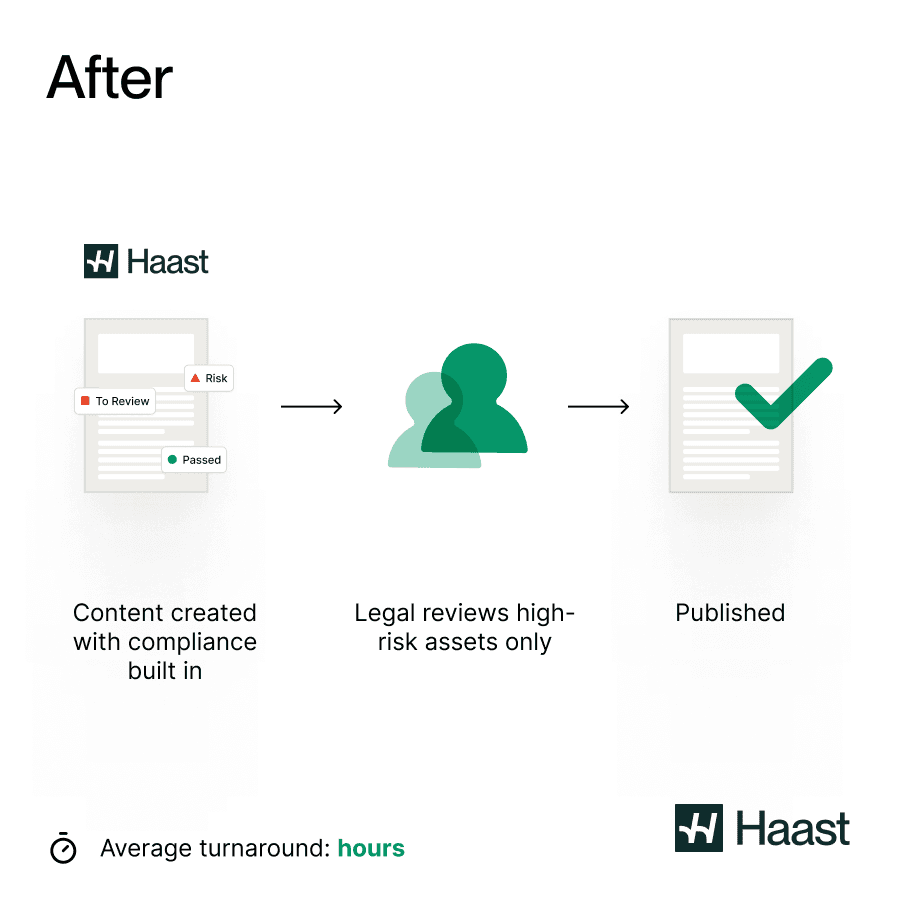
The teams that have genuinely cracked this have stopped treating compliance as a final gate. They've embedded it into the workflow itself, so checks happen during creation, not after it.
When the Volume Outpaces Manual Review, You Need Technology
At the scale AI makes possible, manual governance isn't just inefficient. It's insufficient. The volume of content marketing teams are now producing cannot be reviewed, checked, and approved through human effort alone without either creating a bottleneck that kills your speed or thinning the review to the point it stops meaning anything. In regulated industries, both of those outcomes carry real consequences. Technology isn't a nice-to-have at this scale. It's the only way to make compliance work.
The teams that have genuinely cracked this have stopped treating compliance as a final gate. They've embedded it into the workflow itself, so checks happen during creation, not after it.
"We use Haast on our own marketing. Every piece of content we publish goes through the same compliance checks we ask our clients to run. If we're going to tell enterprise marketing teams that continuous compliance monitoring is achievable at scale, we should be able to demonstrate it on ourselves first."

Chloe Stevens
Marketing Lead, Haast
How Zurich Insurance Scales Marketing, Compliantly
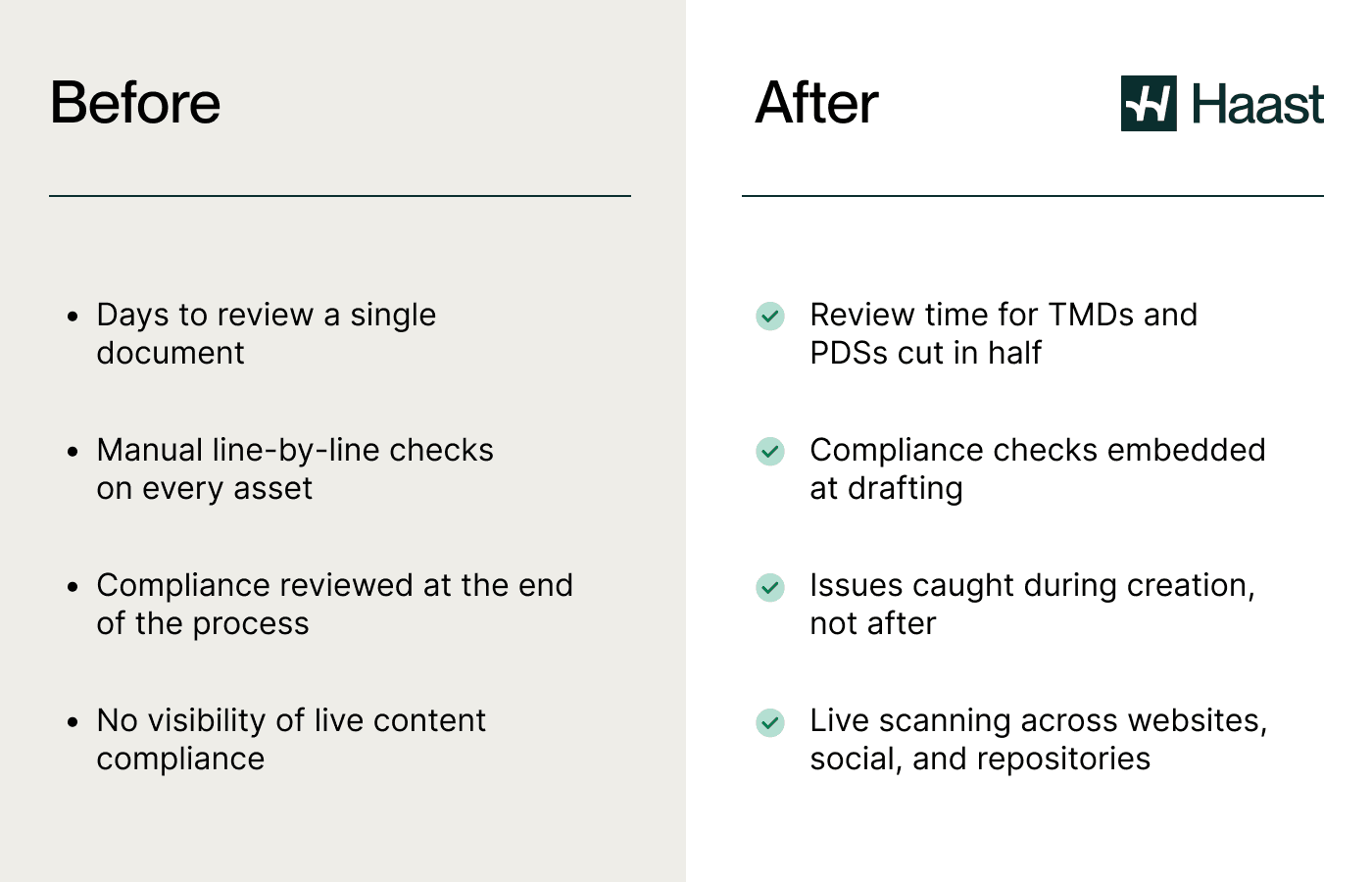
Zurich is one of the world's largest insurance providers. Every piece of their marketing and customer content (product disclosure statements, target market determinations, social posts, customer communications) carries real regulatory weight. Before Haast, all of it went through the same manual line-by-line review regardless of risk level or scale of change. The process wasn't broken. It just wasn't built for the volume they were dealing with.
How Zurich Insurance Scales Marketing, Compliantly
Zurich is one of the world's largest insurance providers. Every piece of their marketing and customer content (product disclosure statements, target market determinations, social posts, customer communications) carries real regulatory weight. Before Haast, all of it went through the same manual line-by-line review regardless of risk level or scale of change. The process wasn't broken. It just wasn't built for the volume they were dealing with.

Haast integrates directly into Zurich's content workflows, so compliance feedback arrives while documents are being written rather than at the end of a review cycle. The back-and-forth that was eating days out of every campaign is now handled in real time. And our live scanning across Zurich's websites, social channels, and repositories means their compliance position is visible continuously, not just at the point of approval.

"Before, we had to do every compliance check manually. Now, with Haast, we can draft documents much faster. We've always had Spell Check in Microsoft Word – now we have the Haast Check for compliance."

Head of Regulatory Change, Frameworks & Insights
Zurich
"Before, we had to do every compliance check manually. Now, with Haast, we can draft documents much faster. We've always had Spell Check in Microsoft Word – now we have the Haast Check for compliance."

Head of Regulatory Change, Frameworks & Insights
Zurich
Section 4
Section 4
How to Build the Guardrails That Make Speed Safe
Technology gives you the infrastructure. But the businesses getting the most out of it aren't just the ones that bought the right tool, they're the ones that built the right processes around it. Without clear guardrails, governance ownership, and structured training, even the best technology produces inconsistent results. And the teams that have got this right share a common starting point: they stopped treating governance as compliance overhead.
Governance Isn't Your Compliance Overhead. It's Your Competitive Advantage
Most governance models weren't built for this volume. They were built for a world where content moved slower and teams were smaller. That world is gone.
The teams pulling ahead have stopped treating compliance as something that happens after content is created. They've built it into the process itself. At DHL, that means pre-approved messaging blocks, standardized prompts, shared template libraries, and a risk-based approval model that reserves detailed review for the content that actually needs it.
The most mature businesses don't treat governance as risk mitigation. They treat it as the infrastructure that makes speed possible. At Optus, that meant creating a dedicated structure to own the question across the whole marketing function:
How to Build the Guardrails That Make Speed Safe
Technology gives you the infrastructure. But the businesses getting the most out of it aren't just the ones that bought the right tool, they're the ones that built the right processes around it. Without clear guardrails, governance ownership, and structured training, even the best technology produces inconsistent results. And the teams that have got this right share a common starting point: they stopped treating governance as compliance overhead.
Governance Isn't Your Compliance Overhead. It's Your Competitive Advantage
Most governance models weren't built for this volume. They were built for a world where content moved slower and teams were smaller. That world is gone.
The teams pulling ahead have stopped treating compliance as something that happens after content is created. They've built it into the process itself. At DHL, that means pre-approved messaging blocks, standardized prompts, shared template libraries, and a risk-based approval model that reserves detailed review for the content that actually needs it.
The most mature businesses don't treat governance as risk mitigation. They treat it as the infrastructure that makes speed possible. At Optus, that meant creating a dedicated structure to own the question across the whole marketing function:
"Establishing an AI Center of Excellence ensures that there’s clear guidance on how AI should be used across marketing. It’s not about restricting teams – it’s about helping them use AI safely, consistently, and effectively. The Center of Excellence provides approved tools, recommended use cases, and clear guardrails so teams don’t have to figure it out on their own. That gives people confidence to adopt AI, because they know they’re operating within safe and trusted boundaries."

Silvia Dominguez
Customer & Marketing Executive, former Optus
"Establishing an AI Center of Excellence ensures that there’s clear guidance on how AI should be used across marketing. It’s not about restricting teams – it’s about helping them use AI safely, consistently, and effectively. The Center of Excellence provides approved tools, recommended use cases, and clear guardrails so teams don’t have to figure it out on their own. That gives people confidence to adopt AI, because they know they’re operating within safe and trusted boundaries."

Silvia Dominguez
Customer & Marketing Executive, former Optus
The Guardrails That Actually Make a Difference
The guardrails that actually make a difference aren't theoretical. They show up in how work actually gets done day to day. Four pillars come up consistently among the businesses that have got this right.
Pre-Approved Building Blocks
Messaging frameworks, approved claims, and required disclosures your teams can draw from without starting from scratch. At DHL, these sit at the center of the content workflow across 220 markets. Teams build from a compliant foundation rather than clearing a compliance hurdle after the content is written.
Standardized Prompts
Organization-designed prompts encode your brand voice and regulatory requirements into the AI instruction itself, so compliance requirements travel with every piece of content the tool produces. The prompt becomes the guardrail.
The Guardrails That Actually Make a Difference
The guardrails that actually make a difference aren't theoretical. They show up in how work actually gets done day to day. Four pillars come up consistently among the businesses that have got this right.
Pre-Approved Building Blocks
Messaging frameworks, approved claims, and required disclosures your teams can draw from without starting from scratch. At DHL, these sit at the center of the content workflow across 220 markets. Teams build from a compliant foundation rather than clearing a compliance hurdle after the content is written.
Standardized Prompts
Organization-designed prompts encode your brand voice and regulatory requirements into the AI instruction itself, so compliance requirements travel with every piece of content the tool produces. The prompt becomes the guardrail.
"Prompts matter more than tools. A single well-designed prompt can save hours of manual editing. When you’re scaling, consistency matters more than constant experimentation."

Lee Nelson
VP Global Marketing and Communications, DHL
"Prompts matter more than tools. A single well-designed prompt can save hours of manual editing. When you’re scaling, consistency matters more than constant experimentation."

Lee Nelson
VP Global Marketing and Communications, DHL
Structured Training Across Your Team
Most teams deploy AI and assume adoption will follow. It doesn't. Without structured guidance, people default to their own prompts, their own interpretations of brand voice, and their own judgment about what AI can be trusted with. That inconsistency is exactly what governance is designed to prevent.
The teams getting this right treat training as an ongoing part of how the function operates, covering prompt design, brand voice, AI limitations, and when human judgment needs to take over.
Structured Training Across Your Team
Most teams deploy AI and assume adoption will follow. It doesn't. Without structured guidance, people default to their own prompts, their own interpretations of brand voice, and their own judgment about what AI can be trusted with. That inconsistency is exactly what governance is designed to prevent.
The teams getting this right treat training as an ongoing part of how the function operates, covering prompt design, brand voice, AI limitations, and when human judgment needs to take over.
"AI adoption isn't just about giving people access to tools – it's about giving them the skills and confidence to use them well. We've invested in structured training so teams understand not just how to use AI, but when to use it – and when not to."

Ariana Miller
Director of Marketing, Envato
"AI adoption isn't just about giving people access to tools – it's about giving them the skills and confidence to use them well. We've invested in structured training so teams understand not just how to use AI, but when to use it – and when not to."

Ariana Miller
Director of Marketing, Envato
A Named Owner for AI Governance
Someone needs to own the prompts, the training, the standards, and the accountability. Without that, everyone is effectively running their own ungoverned AI practice.
A Named Owner for AI Governance
Someone needs to own the prompts, the training, the standards, and the accountability. Without that, everyone is effectively running their own ungoverned AI practice.
"Assign accountability to someone. If you have someone internally championing this, it’s a lot easier. You really need to hero someone to do it. Just assuming that everybody is off on their own looking at AI and working through it – that’s the wrong assumption."

Ariana Miller
Director of Marketing, Envato
"Assign accountability to someone. If you have someone internally championing this, it’s a lot easier. You really need to hero someone to do it. Just assuming that everybody is off on their own looking at AI and working through it – that’s the wrong assumption."

Ariana Miller
Director of Marketing, Envato
Where to Start: Know Where Your Risk Actually Lives
Knowing what guardrails to build is one thing. Knowing where to apply them is another. Before you can fix your governance model, you need to know where your risk actually lives. Most marketing teams, when they look at this clearly, find that a large proportion of their content carries low compliance risk and is going through the exact same review process as high-risk content. Fixing that misallocation is often the fastest win.
The framework below is a starting point for tiering your content by risk level. The goal isn't to reduce oversight on content that needs it, but to automate the compliance checks where possible.
Where to Start: Know Where Your Risk Actually Lives
Knowing what guardrails to build is one thing. Knowing where to apply them is another. Before you can fix your governance model, you need to know where your risk actually lives. Most marketing teams, when they look at this clearly, find that a large proportion of their content carries low compliance risk and is going through the exact same review process as high-risk content. Fixing that misallocation is often the fastest win.
The framework below is a starting point for tiering your content by risk level. The goal isn't to reduce oversight on content that needs it, but to automate the compliance checks where possible.
Content Risk Tiering Framework
Tier
Tier
Content Type
Content Type
Risk Indicators
Risk Indicators
Review Approach
Review Approach
Tier 1
(Critical Risk)
Tier 1
(Critical Risk)
Net-new product claims, financial promotions, health or performance claims, regulated disclosures, new market launches
New or unapproved claims, regulatory disclosure requirements, content targeting vulnerable audiences (retail investors, customers in hardship, minors)
Marketing team use AI compliance assistance while drafting and iterating, but we recommend full final sign-off conducted by legal and compliance department.
Tier 2
(High risk)
Tier 2
(High risk)
Paid advertising, pricing or savings claims, promotional offers, influencer marketing
Monetary claims, broad public reach, potential for misinterpretation
Marketing team use AI compliance assistance while drafting and iterating, but we recommend still considering a final sign-off by legal and compliance department.
Tier 3
(Medium risk)
Tier 3
(Medium risk)
Adaptations of approved campaigns, product-referencing social posts, lifecycle emails
Previously approved claims reused, moderate reach
Depending on the organizational risk tolerance -marketing teams could use AI compliance assistance to draft, iterate and launch without legal oversight.
Tier 4
(Low to minimal risk)
Tier 4
(Low to minimal risk)
Template-based content, event invitations, blog posts
Pre-approved templates, no regulated claims
Fully automated compliance checks recommended.
Most teams who do this analysis find that 50-60% of their content sits in Tier 3 and 4 yet is going through a Tier 1 process. Simply knowing that is often enough to start making smarter decisions about where your review effort actually needs to go.
Section 5
Conclusion: Legal Ops in 2026
The AI landscape will only get more complex. But the Legal Ops teams that take a structured, measurable, and pragmatic approach will become the strategic advisors their businesses can’t live without.
AI isn’t about replacing lawyers - it’s about amplifying their judgment. And it starts with one clear problem, one well-chosen tool, and one successful rollout.
And we’ve witnessed this firsthand at Haast; for some of our enterprise clients, the Legal Ops team have been real drivers of step-change for their in-house GCs.
Clients like Telstra, Zurich and Aviva followed the formula of:
Focusing on one high-volume use case first (marketing compliance approvals)
Choosing a vendor that drives immediate value, and works in partnership with them to increase adoption
The result: An 80% reduction in the time it takes to conduct content compliance checks within 12 weeks.
These global businesses didn’t get these results by chasing hype, but by starting small, defining ROI early, and choosing AI that fits how they work.
For Legal Ops leaders globally, the challenge is no longer “should we use AI?” - it’s how to use it well.
Section 5
Where AI-Powered Marketing is Heading in 2026
AI-supported production has crossed a threshold. First-pass copy, creative variants, localization, campaign ideation: these are no longer competitive advantages. They are table stakes. The teams still doing this work entirely manually are falling behind, and the gap widens every quarter.
"No one wants to be the Blockbuster or the BlackBerry of today. Those brands weren’t lacking recognition or scale – but they didn’t keep up with marketing technology and that’s how they got left behind. The risk of not scaling your output is lagging behind: you lose your position in the market."

Ariana Miller
Director of Marketing, Envato
The question that follows isn't how much you should use AI. It's whether you’re using it correctly, consistently, and compliantly, and whether the time AI returns is going toward work that actually moves your brand forward.
Governance is Moving Upstream. Is Yours?
The governance model most marketing teams are still running was designed for a different era: review content after it's created, catch issues before publication, approve at the gate. That model was already under strain before AI scaled your output. At high volume, it becomes a single point of failure.
The businesses ahead of this problem have moved governance into the creation process itself. Compliance requirements are encoded into prompts. Pre-approved building blocks eliminate categories of risk before a word is written. Live monitoring surfaces issues in published content before they become incidents. The approval gate doesn't disappear, it becomes one layer in a system rather than the whole system.
A Quick Readiness Check
Before you scale further, ask yourself:
Do you have standardized prompts that encode your brand voice and compliance requirements?
Have you mapped your content by risk tier and adjusted review processes to match?
Do you have the technology/tools in place to make those checks scalable, rather than relying on manual review?
Are compliance checks embedded in drafting, or only applied as a final gate?
Do you have visibility of what's currently published across all your channels?
Is there a named owner for AI governance in your marketing function?
The Brands That Cut Through Will Be the Ones That Sound Like Themselves
Here is the counterintuitive consequence of widespread AI adoption: in a market where generating large volumes of content has become cheap and fast, consistency and authenticity become the competitive advantages.
AI has lowered the cost of production, but it hasn't made it easier to produce content that accurately reflects your brand's voice, values, and regulatory commitments at scale. That still requires deliberate infrastructure: the prompts, frameworks, and governance models that encode what your brand actually is and embed it into every output the AI produces.
In financial services, healthcare, and insurance, customer trust isn't won through content volume. It's built through consistent, accurate, compliant communication over time. The brands that scale output while maintaining that consistency will compound their trust advantage. Those that scale without the governance to match are compounding compliance debt instead. Within a few years, the gap between those two trajectories will be clearly visible.
Speed and Safety Are Not a Trade-off
The marketing teams handling this well aren't the ones being the most cautious. They're the ones that built the infrastructure to move fast without accumulating the risk that comes back to bite you.
AI hasn't changed your compliance obligations. It's made them harder to meet at scale, which is why the gap between production capacity and governance capacity is where brands get into trouble.
We've seen this firsthand. The clients that have cracked it – Zurich, Telstra, Aviva – didn't do it by slowing down or restricting AI use. They did it by building governance into how work gets done: pre-approved building blocks, standardized prompts, risk-tiered approvals, and compliance checks embedded at drafting rather than bolted on at the end. The result is teams that move faster, not slower, because the compliance question has already been answered by the system before it reaches a reviewer.
The challenge for marketing leaders in 2026 isn't whether to scale with AI. It's whether your governance is scaling with it.