The promise of generative AI in marketing is speed. Campaigns that once took weeks to produce can now be drafted in minutes. Social copy, email sequences, landing pages, ad variations - AI tools can generate all of it at a pace that no human team could match.
But speed without governance is a liability. And for regulated industries – including marketing compliance for financial services, healthcare, telecommunications, and gaming - the risks of ungoverned AI-generated content could be catastrophic. They are already materializing in enforcement actions, regulatory guidance, and boardroom conversations about brand risk.
Marketing teams are adopting AI tools faster than compliance frameworks can adapt. Here’s a closer look at what’s happening, the current regulatory landscape and upcoming regulatory changes, and how marketing compliance software can support enterprise compliance strategy.
What makes AI content compliance different
The volume problem
Traditional compliance workflows were designed for human-paced content production. A team might produce 20 to 50 pieces of content per week, each passing through a structured review process. AI tools can generate that volume in an afternoon. When output scales by 10x but review capacity stays flat, content starts going live without adequate oversight.
The hallucination problem
Large language models generate plausible-sounding text. They do not verify facts. In regulated industries, this means AI can confidently produce claims that are misleading, unsubstantiated, or outright non-compliant. A financial services AI-generated draft might reference a product benefit that does not exist. A healthcare AI-generated draft might imply clinical efficacy without proper substantiation. These are not edge cases - they are inherent characteristics of how generative AI works.
The provenance problem
When a human copywriter makes a claim, you can ask them where it came from. When AI generates content, there is no audit trail for why specific language was chosen, what training data informed the output, or whether the claim has been validated. For organizations that need defensible compliance records, this is a fundamental gap.
The consistency problem
AI tools do not inherently understand your organization's compliance policies. They generate content based on patterns in training data, not your approved messaging framework. The same prompt can produce different outputs each time - some compliant, some not. Without a governance layer, every piece of AI-generated content is a coin flip.
The regulatory landscape
Regulators globally are moving quickly to address AI-generated content in marketing. The frameworks are still evolving, but the direction is consistent: organizations are responsible for the content they publish, regardless of whether a human or AI produced it.
Regulation / Framework | Region | Regulator | How It Applies to AI Marketing Content |
EU AI Act | EU | Requires transparency obligations for AI-generated content. Marketing materials produced by AI may need disclosure. High-risk use cases face additional requirements. | |
FTC Act (Section 5) | US | Prohibits unfair or deceptive practices. AI-generated claims that are false, misleading, or unsubstantiated trigger the same liability as human-written claims. The FTC has explicitly stated that using AI does not absolve responsibility. | |
Australian Consumer Law | Australia | Misleading or deceptive conduct provisions apply regardless of how content is produced. AI-generated marketing that misleads consumers exposes the organization to enforcement action. | |
Consumer Protection from Unfair Trading Regulations | UK | The ASA has confirmed that AI-generated advertising must meet the same standards as human-created ads. Responsibility sits with the advertiser. | |
DORA / MiFID II | EU | ESMA / National regulators | Financial services firms using AI to generate marketing content must ensure outputs meet existing fair, clear, and not misleading requirements. |
Read about regulatory pressure points to watch out for this year in the US, UK and Australia.
What is changing in 2026
The EU AI Act Is moving from framework to enforcement
The EU AI Act's transparency requirements are beginning to take practical effect. Organizations that use AI to generate consumer-facing content - including marketing - need to assess whether their use cases trigger disclosure or documentation obligations. The compliance burden is not just about labelling AI content. It extends to demonstrating that appropriate human oversight exists in the content production process.
Regulators are targeting AI-washing
Just as greenwashing enforcement accelerated over the past two years, regulators are now scrutinizing AI-related claims. This cuts both ways for marketing teams: claims about your own AI capabilities must be substantiated, and claims generated by AI about your products must be accurate. The FTC has issued specific guidance warning companies against making deceptive AI claims.
Industry-specific regulators are issuing AI guidance
Financial regulators, healthcare bodies, and telecommunications authorities are all publishing guidance on AI use in customer-facing communications. The common thread: the organization publishing the content bears full responsibility for its accuracy, regardless of how it was produced. "The AI wrote it" is not a defence.
Internal governance expectations are rising
Beyond external regulation, boards and executive teams are demanding clearer governance over AI use in marketing. The reputational risk of an AI-generated compliance failure - a misleading claim, an offensive output, a hallucinated statistic - is driving organizations to formalise AI content governance before regulators force them to.
Where AI content compliance breaks down
Scenario 1: The hallucinated claim
A financial services marketing team uses an AI tool to generate social media content promoting a new savings product. The AI drafts a post stating that the product "guarantees returns above the market average." No human reviewer catches the language before it goes live across three platforms. The claim is unsubstantiated and potentially misleading under both FTC and ASIC guidelines.
The problem is not that the AI made a mistake. The problem is that no governance layer existed between generation and publication. The content was never checked against the organization's approved claims library or regulatory obligations.
Scenario 2: The inconsistent campaign
A telecommunications company uses AI to generate localized ad variations for a promotional offer across the US, UK, and Australia. The core offer is compliant, but the AI generates different qualifying language for each market. In one variation, the qualifying terms are buried. In another, they are omitted entirely. The organization does not discover the inconsistency until a consumer complaint triggers a regulatory review.
The challenge here is scale. Manual review of every localized variation is impractical at the volume AI enables. But without systematic checks, inconsistencies become invisible until they become enforcement actions.
Scenario 3: The audit trail gap
A healthcare marketing team uses AI to draft educational content about a therapeutic area. The content is reviewed and approved internally. Six months later, a regulator requests documentation of the review process - specifically, what compliance checks were performed, who approved the content, and what the original AI-generated draft looked like before edits. The team cannot produce this documentation because their workflow did not capture it.
The content itself may have been compliant. But without a defensible audit trail, the organization cannot demonstrate that compliance was intentional.
What a compliance system needs to do
Governing AI-generated content is not about blocking AI adoption. It is about building infrastructure that lets marketing teams use AI confidently while maintaining compliance standards.
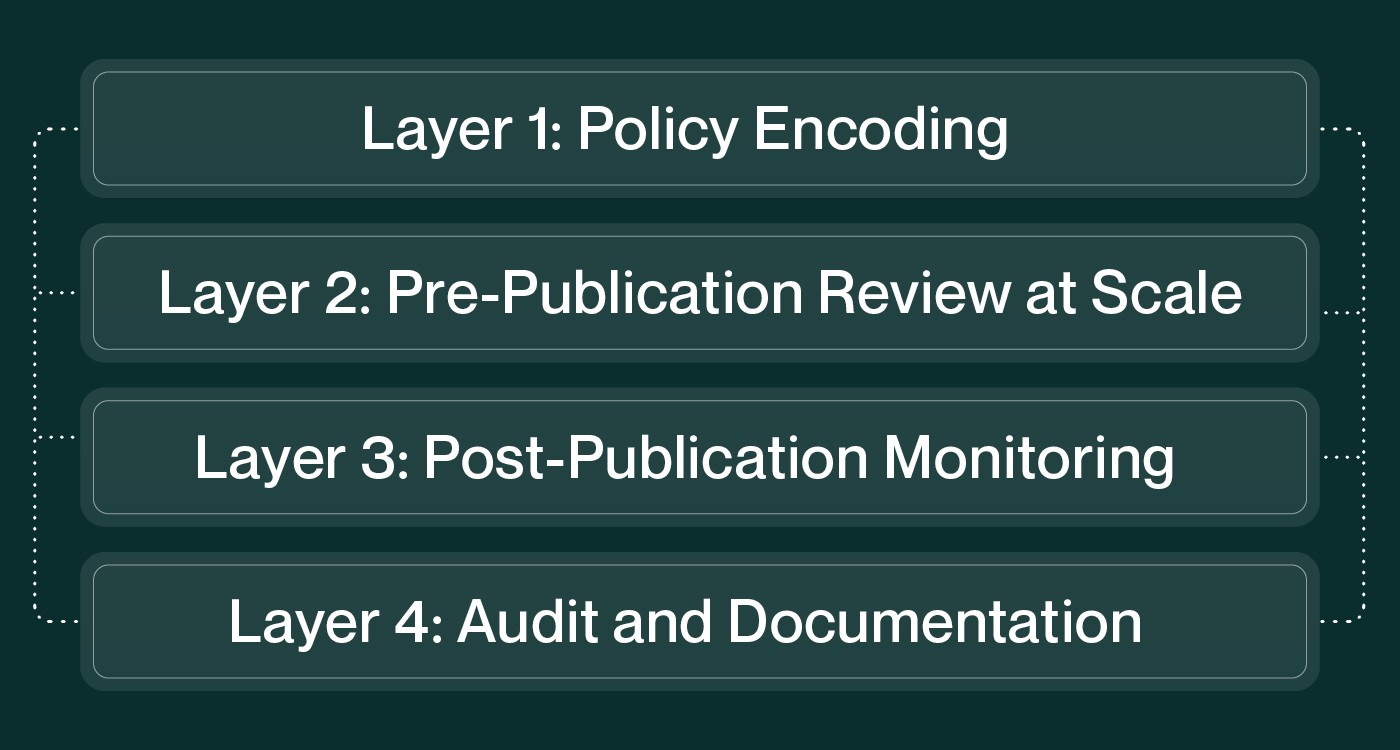
Layer 1: Policy encoding
Bespoke risk tolerance: your organization's specific compliance policies encoded into the review system, not generic industry rules
Jurisdiction-aware checks: content that will be published in multiple markets checked against each market's regulatory requirements
Brand and tone governance: beyond legal compliance, AI content must match your organization's voice and approved messaging
Layer 2: Pre-publication review at scale
Automated claim verification: every AI-generated claim checked against your regulatory requirements and product documentation before publication
Risk scoring: content flagged by risk level so human reviewers focus on high-risk items, not every single output
Channel and geographic-specific checks: different channels have different requirements. Social media disclaimers, email opt-out language, landing page terms - each needs its own compliance logic
Layer 3: Post-publication monitoring
Continuous live scanning: content that was compliant at publication can become non-compliant as regulations change, offers expire, or claims become outdated
Drift detection: identifying when published content has deviated from its approved version
Layer 4: Audit and documentation
Full version history: every draft, review, edit, and approval captured with timestamps
Reviewer attribution: clear records of who reviewed what and when
Regulatory response readiness: documentation structured so that regulatory requests can be answered quickly, not reconstructed after the fact
How these scenarios play out differently with Haast
Haast is built for exactly this challenge - governing content at scale across regulated industries, whether that content is written by humans or generated by AI.
The hallucinated claim gets caught before publication. Haast's compliance engine checks every piece of content against your organization's bespoke risk tolerance and approved claims. The "guaranteed returns" language is flagged immediately because it conflicts with both the approved product messaging and the regulatory requirements encoded in the system. The marketing team sees the flag, corrects the language, and publishes with confidence.
The inconsistent campaign is caught systematically. Haast checks each localized variation against the relevant jurisdiction's requirements. The missing qualifying terms in the Australian variation are flagged before the campaign launches. The buried terms in the UK variation are highlighted as a readability risk. Every variation is documented with a defensible audit trail showing exactly what was checked and approved.
The audit trail exists from day one. Haast captures the full lifecycle of every piece of content - from AI-generated draft through review, editing, approval, and publication. When the regulator requests documentation six months later, the healthcare team can produce a complete, timestamped record in minutes rather than scrambling to reconstruct it.
Haast's implementation is led by a team of former lawyers who understand regulatory nuance - not generic customer success. And the system continuously learns from every review and feedback loop, improving accuracy and calibrating to your organization's evolving risk tolerance over time.
See how Zurich cut compliance review times by 50% using the same compliance AI platform to govern content at scale.
Book a demo
If your organization is scaling AI-generated content and needs a governance framework that keeps pace, book a demo with the Haast team today.
Team Haast