by Liam King, Haast co-founder
In the fintech space, product portfolios have doubled to quadrupled since 2018, across every region. Launch gaps between competitors are getting smaller, and every new product brings with it new regulatory requirements. Regulators worldwide are watching: they’ve fined fast movers on three continents, citing compliance that “did not keep pace” with growth:
Block, which owns and operates Cash App, agreed to a US$40m fine to settle charges with the New York Department of Financial Services regarding significant compliance failures
The UK Financial Conduct Authority fined Starling Bank £29m for "shockingly lax" financial crime controls and anti-money laundering failings
The FCA fined Monzo Bank Ltd £21m for serious weaknesses in its anti-financial crime and anti-money laundering controls
A decade ago, the pitch was simple: Robinhood sold stock trading, Monzo sold a debit card, Nubank sold a purple credit card, Toss moved money between friends. One product, one regulator, one jurisdiction.
Now, the market-defining watchword belongs to regulators: "did not keep pace." In this article, we’ll explore how the industry got from there to here, and what teams that still ship quickly do differently.
Old model: One product, one regulator, one jurisdiction
For a start, no fast-moving fintech sells just one product anymore. Robinhood runs 13 product verticals; Monzo runs nine – from current accounts through pensions and, since April, contents insurance; Nubank runs 14, including a phone network; Toss runs nine, including a licensed bank and a securities arm. Across our dataset, the average fast-moving fintech operated between two and 3.4 product verticals in 2018. Today the US Tier-1 cohort and the UK cohort average five, Europe 7.3, APAC 8.5, and Latin America 9.2.
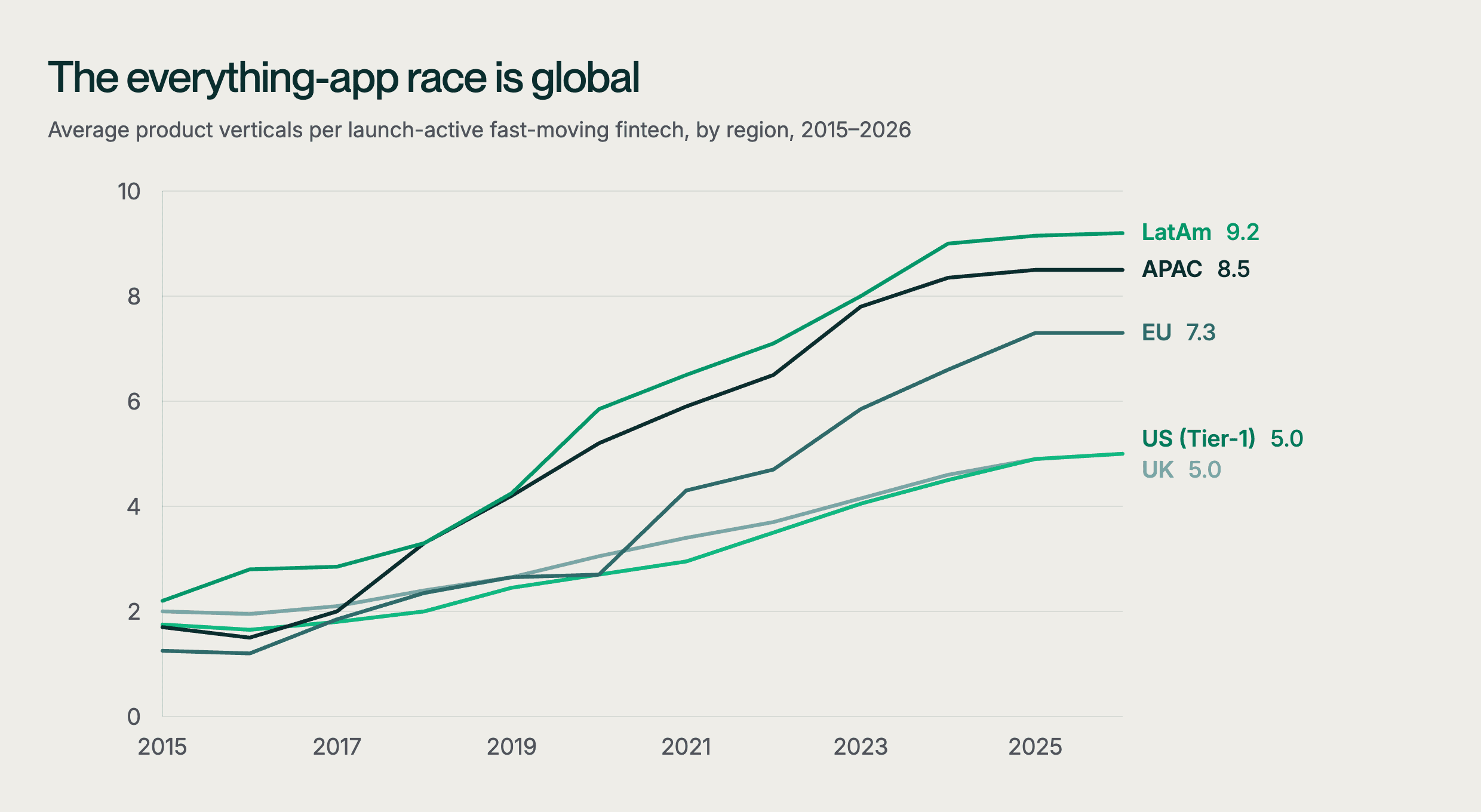
Product verticals per fast-moving fintech by region, 2018 vs 2026
In fact, most fintechs simply never thought of themselves as single-product companies. In Latin America and Asia in particular, Mercado Pago grew out of a marketplace, Grab and GoPay out of ride-hailing, Paytm out of phone top-ups. Each treated financial products as items to be added to a shelf.
Where banking penetration was low, the wallet became the bank, then the broker, then the insurer. Nubank now spans 14 verticals to Robinhood's 13, and reached its first $1.1 billion quarterly profit doing it. Europe's cohort, pulled up by Revolut's 19 verticals and Klarna's 10, passed the US average in 2021 and kept going.*
Why do corporate boards want more product lines, not fewer?
The economics behind the sprawl are rational. Net-new customer acquisition has always been more difficult than retaining current clients, and it’s getting harder: Google search cost-per-click rose for 87% of industries in 2025, up 12.9% on average, and the average CPC has more than doubled in a decade[1]. Meta's average price per ad rose 9% across 2025 and was up another 12% year on year in Q1 2026[2]. The organic funnel is shrinking at the same time: 68% of US Google searches now end without a click to the open web, up from 60% in 2024, as AI answers absorb the discovery layer that content marketing used to own[3].
For a financial product, the arithmetic is harsher still, with a single acquired customer already costing between $150 and $780[4], and AEO only now starting to prove it can replace what search sent. Paying those prices to sell one product to each customer is a hard model to defend.
The math is simple: Revenue = customers per market × markets × products per customer × revenue per product.
Growing the first term now means paying $150-$780 a head into rising ad prices. The middle two terms are the cheap ones: selling what you already have in a market you haven't entered, or selling something new to customers you already hold, both at an acquisition cost of roughly zero. And the build cost of those terms keeps falling, because a new line no longer has to be built, only assembled: crypto arrives through Paxos (Nubank and Mercado Pago both launched on its rails), investing through a partner platform (N26's crypto runs on Bitpanda, bunq's stocks on Ginmon, Monzo's investments on BlackRock funds, GCash's crypto on PDAX), and deposit products through sponsor banks and banking-as-a-service providers.
Rent the rails, cross-sell the base, and the launch cost that remains is mostly the one nobody puts on the whiteboard: getting the marketing and the compliance right in a regime you've never operated in.
The companies furthest along say the quiet part on earnings calls. Nubank's David Vélez told his Q1 2026 call the company had "silently" built the largest SME base in Brazil, five million customers "effectively built with 0 customer acquisition cost", and then cross-sold its SME product to them[5]. Klarna's Sebastian Siemiatkowski described the same machine from the other side: an acquisition funnel that "brings in customers at a fraction of the cost that our competitors are spending", converted into "more revenue per customer" through the card and subscriptions[6].
There's a balance-sheet argument stacked on top of the revenue argument. Multiple lines on the same customer base de-risk the revenue itself, and Robinhood's Q2 2026 is the cleanest demonstration in the dataset. Crypto trading revenue, the line Robinhood was once synonymous with, fell 38% year on year. Total revenue still grew 32%, because every one of its major lines now clears $100 million a quarter, and the newest one carried the load: prediction markets, a bet placed in late 2024, did $156 million in the quarter, up more than tenfold in a year, and out-earned crypto[7].
Klarna's subscription line grew more than 600% the same quarter, with two million paying members[8]. A diversified product portfolio does for a fintech's P&L what a diversified fund does for a portfolio: same base, lower variance, and more shots at whichever S-curve arrives next. All else equal, that's shareholder value, which is why Vlad Tenev opened the quarter with a sentence every board now wants to say: "If I had to sum up the quarter, what I'm most excited about is the incredible product velocity."[9]
"When acquiring a customer costs hundreds of dollars and adding a product costs approximately nothing, every new vertical is an arbitrage on the install base you already paid for."
Why are waves of new products coming in faster?
Velocity is measurable, and it's rising in three distinct ways:
Companies reach breadth faster with each generation
Companies ship products faster as they age
Followers arrive sooner every year
Fintechs whose first launch came before 2012 took a median 15.7 years to reach their fifth product vertical. The 2012-2016 class took 6.4 years. The 2017-2020 class took five. Part of that is infrastructure: a 2019-vintage fintech assembles a new product from banking-as-a-service rails, sponsor banks and white-label brokerages that its 2010 predecessor had to build or buy. Part of it is expectation: the funding market now prices multi-product roadmaps into Series B decks.
They also ship faster as they age, which is the opposite of what operational drag would predict. Globally, the median gap between a company's successive launches is 14.5 months in the first half of its life and 10.0 months in the second. EU fast-movers compressed from an 18-month gap to 6.7; APAC from 12 to 7.6; LatAm from 12 to 9.5; the US from 16 to 10.
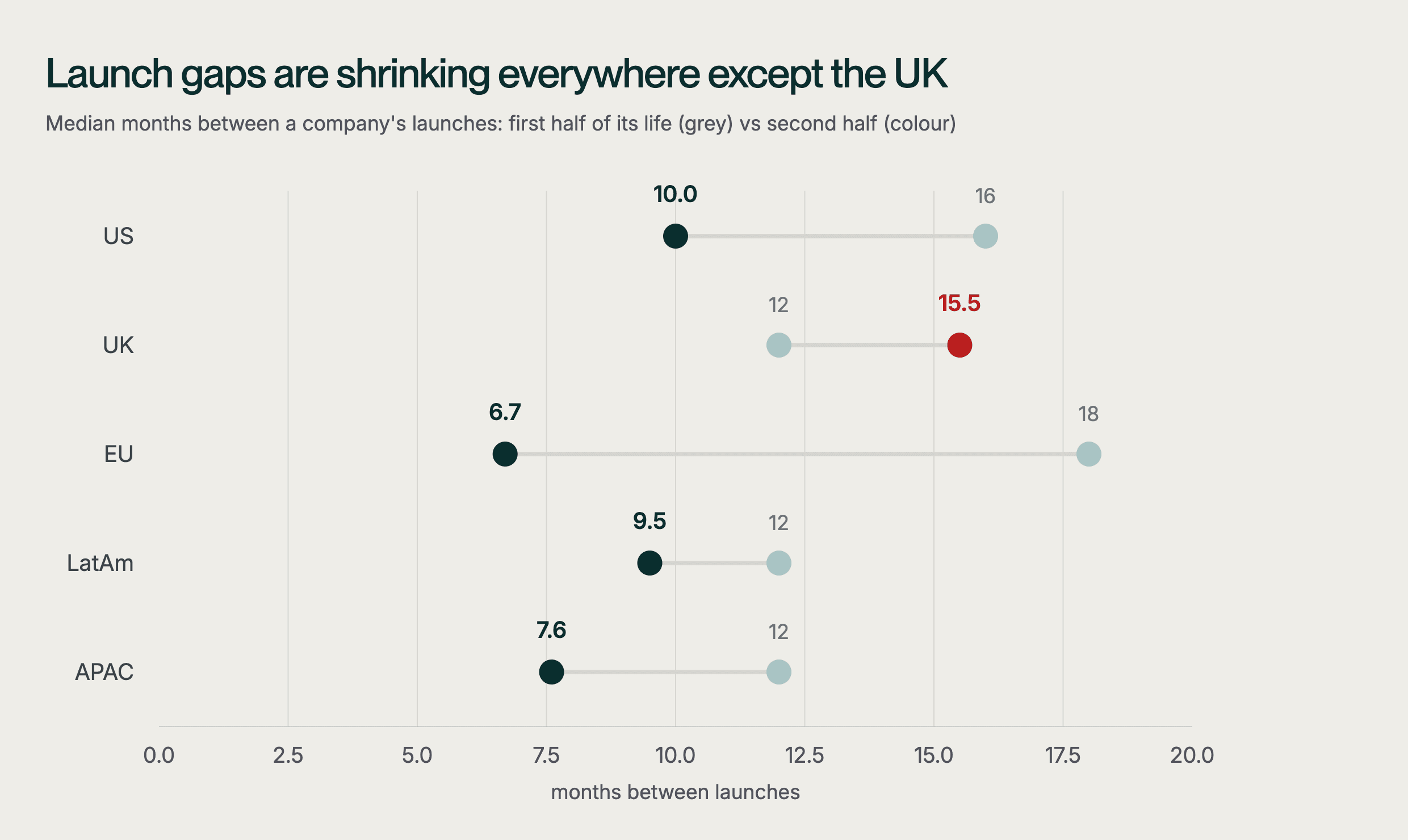
Launch spacing by region: first half vs second half of company life
One region moved the other way, and it's the exception that tests the rule. UK fintechs' launch gaps lengthened, from 12 months to 15.5. The dataset can't prove why, but the timing is suggestive. The FCA's Consumer Duty came into force in July 2023, putting an evidence-and-outcomes burden on every retail product and its marketing[10]; the s21 financial-promotions regime tightened around crypto the same year. A market moving that fast rings like an alarm, and the FCA answered it: 19,766 financial promotions were amended or withdrawn after intervention in 2024, up 97.5% on the year before[11].
"Over the past year, we have seen a growing number of misleading and illegal financial promotions," Lucy Castledine, the FCA's Director of Consumer Investments, said in February 2025. "We have stepped up our efforts in response."[12]
Whether the mechanism is caution in the product committee or capacity in the review queue, UK teams are shipping into more friction than their peers abroad, and the launch counts say their EU rivals aren't waiting for them.
The third acceleration belongs to the market rather than the company: followers arrive sooner every year. For product verticals pioneered before 2015, the first follower took a median 48 months to arrive. For verticals pioneered 2015-2018, 27 months. For those pioneered 2019-2021, 17 months. Whatever differentiation a launch buys now lasts about a year and a half, and each cohort gets less.
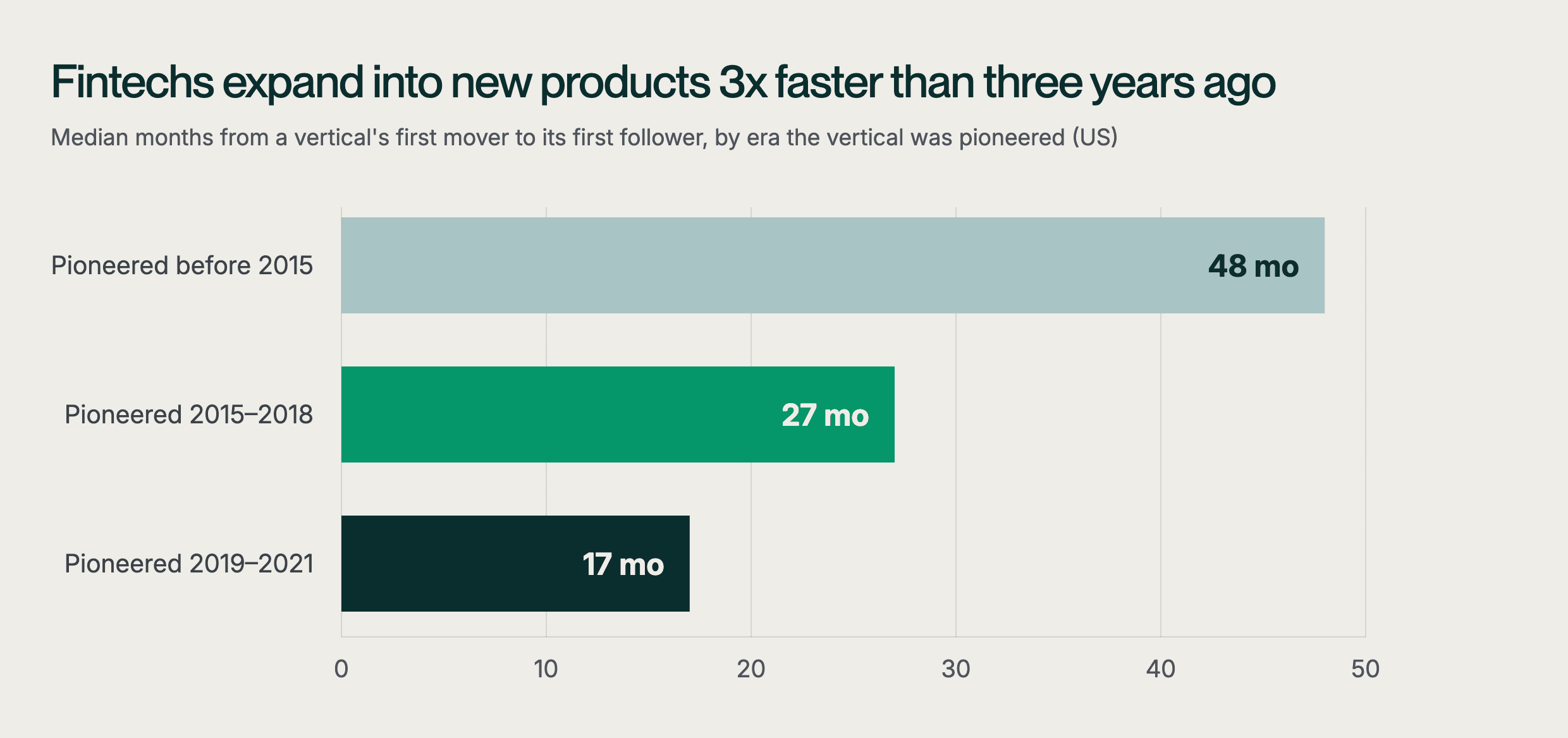
First-follower lag by era pioneered: 48 → 27 → 17 months
Everyone copies everyone, on a measurable schedule
Every fintech ends up with a similar product stack, and the driver is maturity, not a lack of imagination. Challenger fintech is now the size of a mature market, and its customer-acquisition model is suffering everything the incumbents' did before it: comparison sites clipping the funnel, keywords priced like prime real estate, ever more ambitious and expensive brand partnerships. The incumbents hit that wall years ago and gave up, choosing profit margin over TAM expansion. The challengers still want growth, which leaves the most reliable roadmap in the market: whatever a competitor just launched.
And the pull isn't only competitive: fintech customers reward breadth. The new line is often what deepens the relationship, which is why Revolut's Nik Storonsky highlights customers "engaging more deeply by adopting a wider range of our services" as the engine of its results[22]. When your users are asking for the product your competitor just shipped, following fast stops being optional.
We measured how fast the window closes, vertical by vertical, on the US data. When crypto platforms started adding stock trading, the median follower arrived within five months. Cash management swept through retail brokerage in eight; checking accounts spread through the crypto platforms in twelve; even the slower spreads, ETF issuance through the incumbents and equities through the neobanks, ran at 20 to 23 months.
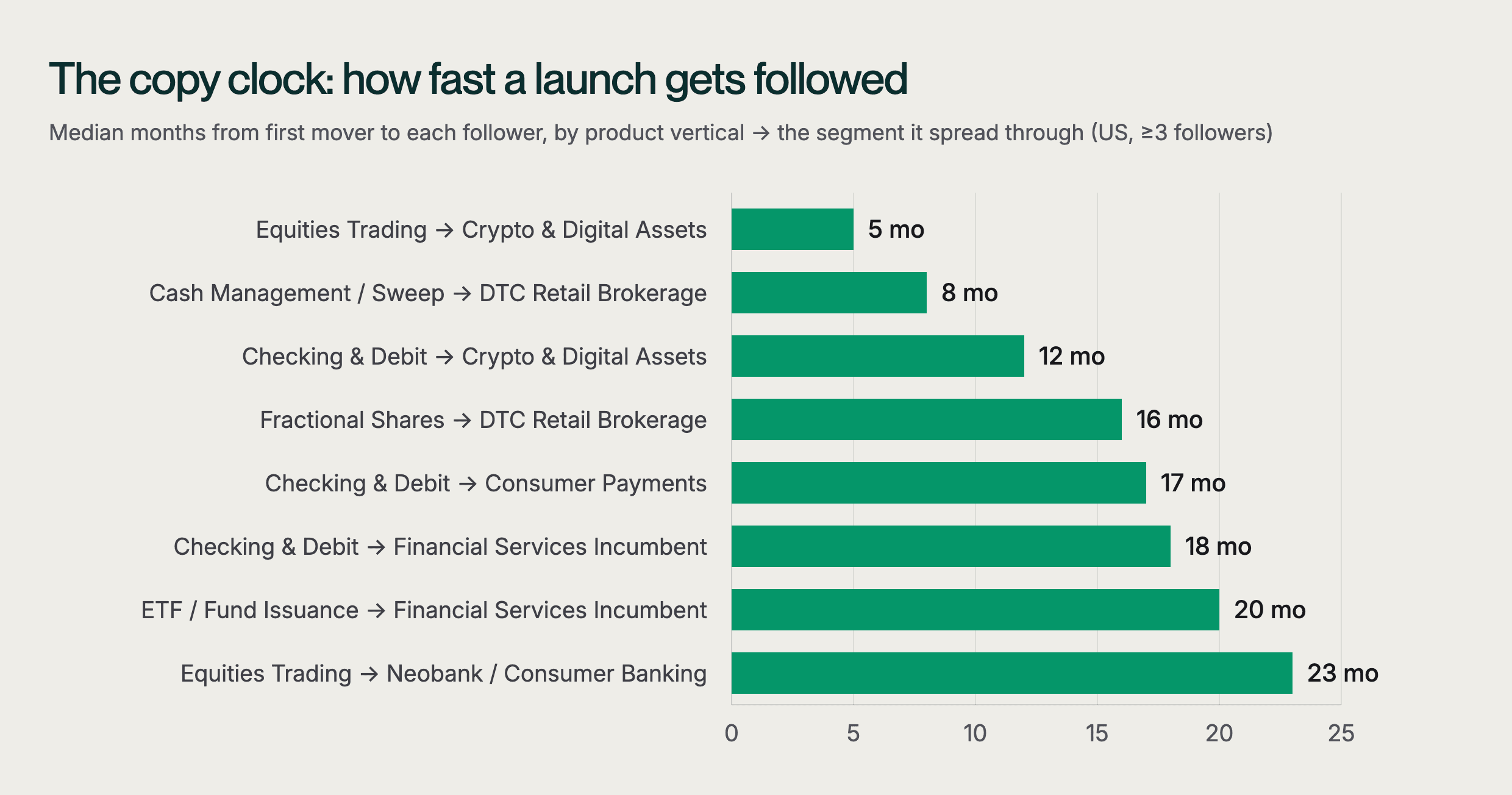
The copy clock: median months from first mover to follower, by vertical
The same dynamic shows up in every region with different names attached. Monzo, Zopa and Kroo followed each other into savings, loans and BNPL. Mercado Pago, PicPay and Uala all added credit cards between 2020 and 2023 once Nubank had proved the model. Toss Bank, GXS, Maya Bank and GoPay's Jago account made four Asian wallets into deposit-takers within 24 months of each other. For a product team that lag is strategy, because it tells you how long your differentiation lasts. For everyone downstream of the product team it's a deadline, because whatever a competitor shipped last quarter is a live candidate for your own roadmap this quarter, whether or not anyone has scoped what it takes to market it lawfully.
The product owner is now doing a different job
Put those three accelerations together and read them from a product owner's perspective.
A decade ago the typical fintech product owner ran one flagship product and launched sequentially: in 2016, 8% of launch-active companies in our dataset shipped two or more products in the same year. In 2025, 30% did. With one product, or a handful, the central functions can align around it: legal, marketing and compliance all learn the same rulebook, review the same kinds of claims, and improve with every cycle.
The modern fintech product owner runs launches in parallel across five to nine live verticals, each with its own roadmap, its own competitor set, and its own regulatory rulebook, and that alignment never gets a chance to form.
The regulatory work is also what quietly stretches the gap between a competitor's launch and your answer to it. Following a competitor into a new vertical isn't just a build: before the marketing can ship, someone has to scan the horizon for the regulatory regime, gather the data, learn the universe of the problem space, and turn all of it into company-specific guidelines a reviewer can actually apply.
In 2018, 7% of the fast-movers in our dataset spanned four or more distinct regulatory families: banking, consumer credit, securities, derivatives, crypto, insurance, payments, pensions. In 2026, 42% do, and the regional averages run from 2.7 families per company in the UK to 5.0 in APAC. In the US data, 59% of Tier-1 launches took the company under a regime it had never marketed under before.
External surveys agree this is where launches go to slow down: in PwC's 2025 Global Compliance Survey of 1,802 executives, 85% said compliance requirements have become more complex in the past three years, and 77% said compliance has hurt five or more growth-driving areas of their business, product launches among them[13]. CUBE's 2025 survey of more than 2,000 senior compliance leaders found 74% of firms take over a year to implement a single new regulation[14], which is longer than the median gap between launches in every region of our dataset. The FCA's Nisha Arora compressed the new steady state into five words: "not a once and done exercise."[15]
Slow costs you the market. Fast costs you the launch, and the regulator doesn't always show up right away. Sometimes it's years after the review capacity fell behind, as in the Starling example. The product launch cycle now runs faster than yearly budgets and headcount extensions: the capacity has to cover more ground than it used to, more marketing assets, across more regimes, in more jurisdictions, while the headcount doing it still grows once a year and the launch cadence runs every ten months.
74% of firms take over a year to implement a single new regulation – longer than the median gap between product launches in every region of our dataset.
Another axis: jurisdictions
Product breadth is only half of the surface, because the same product marketed in a second country carries a second set of promotion rules, and the fastest companies are expanding along both axes at once. We extended the dataset with a market-entry table for the 35 genuinely multi-market fintechs: 184 dated entries, and, tellingly, the exits too. The average multi-market fintech operated in 2.1 regulated market blocks in 2018 and operates in 4.5 today, the same doubling we saw on the product axis. Airwallex went from three markets to fifteen in that window, Revolut from two to ten, Flutterwave from one to nine.
How companies enter has changed as well. Before 2020, most entries were organic launches; since 2020, licensed and acquired entries outnumber them, as companies buy or apply for the rulebook before they ship: a MiCA licence in Luxembourg or Ireland, a banking charter in Mexico, an acquired licensed local in Germany or Korea. The door also swings the other way: roughly one in seven tracked entries has ended in an exit, and the regulator is usually holding the door. N26 left the UK, the US and Brazil; Coinbase left Japan and India before re-entering both; Kraken has now left Japan twice; eToro has trimmed its footprint from around 140 countries to 75; Luno is winding down its entire EU business for want of a MiCA licence; and Monzo announced its US exit in March. Jurisdictions, unlike products, get handed back.
Put the two axes together and you get the number that defines the modern compliance workload. Revolut runs 19 product verticals across ten or more regulated market blocks, which is roughly 190 product-market cells, each one a product being marketed under its own promotion rules. Klarna and Airwallex each sit around 90 cells, Coinbase at 88. Every cell needs its marketing reviewed against its own rulebook, and the cells multiply while the review team adds headcount one budget cycle at a time.
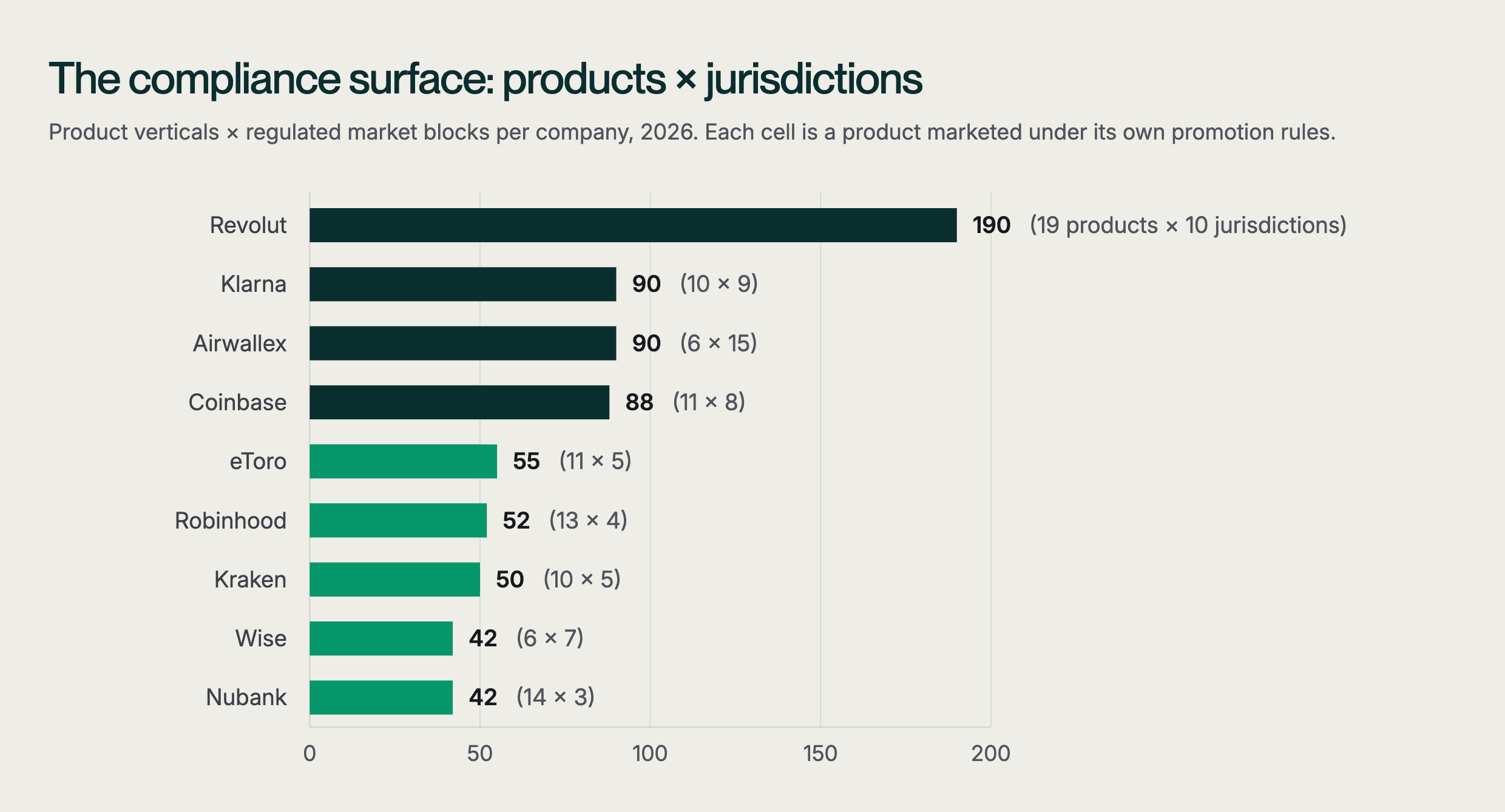
The compliance surface: product verticals × regulated market blocks
“Ship or die” versus the regulator
The imperative to ship still holds. What breaks is a launch that ships without the review capacity it needs, the same way one breaks without the design or engineering capacity it needs, and that now has names and invoice numbers attached.
Regulators on three continents keep writing the same sentence. In the Starling Bank example, the FCA noted the bank had grown from 43,000 customers to 3.6 million while "measures to tackle financial crime did not keep pace with its growth"[16]. For Monzo’s £21 million fine in 2025: controls "failed to keep pace with its customer and product growth"[17]. BaFin didn't wait for a failure at N26; it capped the bank's growth at 50,000 new customers a month for almost three years, writing that "the shortcomings in risk management are due to the bank's substantial growth"[18]. NYDFS took $40 million off Block after Cash App's suspicious-activity backlog grew ninefold, finding its processes "did not keep pace with the significant growth the Company experienced"[19]. Robinhood's record $70 million FINRA penalty in 2021 delivered the same message in product language, compliance "cannot be sacrificed for the sake of innovation"[20], and the ceiling case is Paytm, whose payments bank the RBI shut outright in 2024 for "persistent non-compliances", deleting an entire product line, and the deposits inside it, from one of the dataset's most prolific launchers[21].
What links these cases is that none of them was really about a bad product. In each one, the regulator concluded that the company's compliance function was still built for the smaller, simpler business of two or three years earlier, while the products and the customer base had moved on without it.
Each new launch adds another regime to the pile, but most companies run a single central compliance function across every product line, and when that one team slips, it slips everywhere at once. That is how a sanctions-screening gap at a neobank ends up freezing the growth of the entire company rather than one product. The enforcement lag makes the bill worse: Starling's restriction began in 2021 and the fine arrived in 2024, so the cost of outgrowing your compliance function tends to land about three years after the growth it punishes, at whatever scale you have reached by then.
What did the fastest teams change in their compliance approach?
None of this argues for slowing down. Robinhood trades at roughly 50 times earnings to Charles Schwab's 21, and Nubank at 21 times to Itaú's 9.5, so on both continents a dollar earned by the fast mover is valued at about twice a dollar earned by the incumbent it grew up against[23].
What separates the teams shipping at the front of the pack from the ones collecting regulators' letters is where review sits in the launch. In the fastest companies, review readiness stopped being something a launch waits on and became something a launch is built with, checked at the same gate as a design sign-off or a load test.
In practice, keeping pace with product launches comes down to four habits:
The rule library starts when the competitor ships, not when you do. When a competitor enters crypto trading, the median follower arrives in five months; cash management in eight, checking accounts in 12. Teams that treat that launch as the starting gun have a rule library warming up while their own roadmap is still a rumor.
The launch cadence decides what gets automated. At a launch every ten months across five to nine live products, no review team reads everything, so the first pass on routine, high-volume marketing surfaces runs automatically, and reviewer judgment is saved for what's genuinely new: a claim in an untested regime, a first-of-its-kind fee structure.
The growth curve sets the review schedule, not the launch date. Starling, Monzo, and N26 didn't fail their launch reviews; they failed in the years after, once claim volume outran the team still checking it. So what's already live gets re-checked on a schedule, the same way what's about to ship does.
The regime count sets the budget conversation. Fast movers spanning four or more regulatory families went from 7% to 42% in eight years, while compliance is still staffed and tooled on an annual cycle sized for last year's product line. The fastest teams cost the next regime into the launch that imports it, not into the budget round after the fine.
Learn how Haast helped a company with a complex range of consumer offers cut time to review by 80%
The race is measurable, and it's speeding up on every continent except one, where the regulator got there first. Even there, the slowdown looks more like a pause than a retreat: with Consumer Duty now embedded and two years of review practice behind the UK cohort, the most likely path is that British fintechs get back into the fast lane with the regulator's expectations already built into their launch process. The companies winning the race, in every region, are the ones whose marketing compliance infrastructure absorbs the next product, and the next market, on day one.
Where Haast fits
Legacy marketing compliance workflows aren’t structured for the speed of fast-growing fintechs. But the same technology that enables faster market insights and faster content generation also gets firms up to speed when it comes to compliance.
This is the work Haast’s AI compliance platform already helps teams run today:
Review at scale. Each piece of content is checked – pre-publication as well as live – against your rules. Add new regulatory regimes, markets, and regulatory bodies as needed.
Risk tolerance tuned to your business. Thresholds are set issue-by-issue, so complex products, performance claims, and recommendations get the scrutiny they require.
A complete audit trail. Every decision is traceable back to the rule that triggered it, ready to produce when an examiner asks.
To prepare your compliance team for a more efficient, risk-aware workflow, book a demo.
Liam King combines deep technical expertise with practical industry experience to lead Haast's tech vision. With a background in mathematics, statistics and advanced machine learning, Liam has led large-scale IT transformation projects at Deloitte and excelled in programming at the Australian National University.
Notes and sources
Cohort note: APAC here means Asia plus Australia, with no MENA companies in the sample. The Asia-only average runs higher still, because the two Australian names are single-focus B2B specialists while the Asian super-apps run nine to twelve verticals each.
[1] WordStream by LocaliQ, Google Ads Benchmarks, 2025 and 2026 editions: CPC rose for 87% of industries, +12.88% on average in 2025; 2026 average CPC $5.42 vs $2.32 a decade earlier; Finance & Insurance CPC $3.39-$3.46, cost per lead $74-$84. https://www.wordstream.com/blog/2025-google-ads-benchmarks · https://www.wordstream.com/blog/2026-google-ads-benchmarks
[2] Meta Platforms, Q4/FY2025 and Q1 2026 earnings releases: average price per ad +9% FY2025, +12% YoY Q1 2026. https://investor.atmeta.com/investor-news/press-release-details/2026/Meta-Reports-Fourth-Quarter-and-Full-Year-2025-Results/default.aspx
[3] SparkToro (Datos clickstream), zero-click search studies: 58.5% of US Google searches ended without an open-web click in 2024; 68.0% in Jan-Apr 2026 (reported by Search Engine Land, June 2026). https://sparktoro.com/blog/2024-zero-click-search-study-for-every-1000-us-google-searches-only-374-clicks-go-to-the-open-web-in-the-eu-its-360/ · https://searchengineland.com/google-zero-click-searches-2026-study-479717
[4] eMarketer, citing Fintel Connect's 2025 CPA Benchmarking Guide for Financial Services: financial-industry cost per acquisition generally ranges $150-$780. https://contentstorage-na1.emarketer.com/b28c6764ea724557a4911bb673117008/What_banks_can_do_to_optimize_their_cost_per_acquisition_EMARKETER.pdf
[5] David Vélez, Nubank Q1 2026 earnings call transcript, The Motley Fool, 15 May 2026. https://fool.com/earnings/call-transcripts/2026/05/15/nu-nu-q1-2026-earnings-call-transcript/ · Q2 2026 results (first $1.1B quarterly net income): Business Wire, 13 Aug 2026. https://www.businesswire.com/news/home/20260813187996/en/Nu-Holdings-Ltd.-Reports-Second-Quarter-2026-Financial-Results
[6] Sebastian Siemiatkowski, Klarna Q3 2025 earnings, reported by American Banker, 18 Nov 2025. https://www.americanbanker.com/payments/news/klarna-lays-out-neobank-aspirations
[7] Robinhood Markets, Q2 2026 results, 29 Jul 2026: total net revenue $1.31B (+32% YoY); event contracts $156M (>10x YoY); crypto $100M (-38%); options $342M; equities $129M; net interest $389M. https://investors.robinhood.com/news-releases/news-release-details/robinhood-reports-second-quarter-2026-results
[8] Klarna, Q2 2026 results: revenue $1.042B (+27% YoY); subscription revenue up more than 600% YoY; 2M paying Klarna Memberships subscribers. https://investors.klarna.com/News--Events/news/news-details/2026/Klarna-Reports-Second-Quarter-2026-Results/default.aspx
[9] Vlad Tenev, Robinhood Q1 2025 earnings call, 30 Apr 2025. https://www.marketbeat.com/earnings/reports/2025-4-30-robinhood-markets-inc-stock
[10] Financial Conduct Authority, Consumer Duty, in force 31 July 2023. https://www.fca.org.uk/firms/consumer-duty
[11] Financial Conduct Authority, financial promotions data 2024: 19,766 promotions amended or withdrawn following FCA intervention, vs 10,008 in 2023 (+97.5%). https://www.fca.org.uk/data/financial-promotions-data-2024
[12] Lucy Castledine, Director of Consumer Investments, FCA press release, 7 Feb 2025. https://www.fca.org.uk/news/press-releases/fca-steps-action-against-misleading-financial-adverts
[13] PwC, Global Compliance Survey 2025 (1,802 executives, 63 territories); quote: Shaun Willcocks, Global Risk Markets Leader, PwC Japan. https://www.pwc.com/gx/en/issues/risk-regulation/global-compliance-survey.html
[14] CUBE, The Cost of Compliance Report 2025 (2,000+ senior compliance, risk and legal leaders across 11 markets). https://cube.global/resources/report/the-cost-of-compliance-report-2025
[15] Nisha Arora, FCA, "The Consumer Duty: not once and done", speech, 1 Nov 2023. https://www.fca.org.uk/news/speeches/consumer-duty-not-once-and-done
[16] FCA press release and final notice, Starling Bank, £28,959,426, 2 Oct 2024. https://www.fca.org.uk/news/press-releases/fca-fines-starling-bank-failings-financial-crime-systems-and-controls
[17] FCA press release, Monzo Bank, £21,091,300, 8 Jul 2025. https://www.fca.org.uk/news/press-releases/fca-fines-monzo-21m-failings-financial-crime-controls
[18] BaFin measure, 9 Nov 2021: N26 new-customer cap of 50,000/month (lifted June 2024); fines €4.25M (2021) and €9.2M (2024). https://www.bafin.de/SharedDocs/Veroeffentlichungen/EN/Massnahmen/60b_KWG_84_WpIG_und_57_GwG/meldung_211109_60b_N26_en.html
[19] NYDFS consent order, Block Inc., $40M, 10 Apr 2025; see also CFPB order, $175M, 16 Jan 2025, and 48-state CSBS settlement, $80M, 15 Jan 2025. https://www.dfs.ny.gov/industry-guidance/enforcement-discipline/ea20250410-block
[20] FINRA news release, Robinhood Financial, ~$70M total, 30 Jun 2021; see also SEC, $45M, Jan 2025, and FINRA, $29.75M, Mar 2025. https://www.finra.org/media-center/newsreleases/2021/finra-orders-record-financial-penalties-against-robinhood-financial
[21] Reserve Bank of India, press release on Paytm Payments Bank, 31 Jan 2024. https://www.rbi.org.in/Scripts/BS_PressReleaseDisplay.aspx?prid=57224
[22] Nik Storonsky, Revolut 2024 annual results: customers "engaging more deeply by adopting a wider range of our services across both our retail offering and Revolut Business". https://www.revolut.com/en-US/news/record_growth_and_diverse_product_offering_drive_revolut_to_1_4bn_profit_in_2024/
[23] Trailing P/E ratios at close, 25 Aug 2026: Robinhood 49.6 · Charles Schwab 20.7 · Nu Holdings 20.6 · Itaú Unibanco 9.5 (stockanalysis.com). Multiples price expected growth broadly, not product velocity alone. https://stockanalysis.com/stocks/hood/ · https://stockanalysis.com/stocks/nu/
Method note: dataset v0.3, August 2026. 297 companies: 242 US (the v0.2 universe) plus 55 fast-moving fintechs across the UK, EU, Latin America, APAC (Asia plus Australia; no MENA) and Africa; 1,255 product-launch rows, each carrying a dated public source. The non-US sample is a selected fast-mover cohort, so regional averages are compared against the US Tier-1 cohort, not the full US universe. Launch spacing is the median gap between successive launches within a company, first half versus second half of its observed life. Regulatory families use a published vertical-to-regime-family mapping. The market-entry table covers 35 multi-market companies (184 dated entries and exits); an 'EEA' passported launch counts as one market block, so per-company market counts are conservative. Vertical copy lags and first-follower lags are computed on US data, restricted to verticals pioneered by 2021 to limit censoring; year-precision date ties are excluded. Partner-rail examples (Paxos, Bitpanda, Ginmon, BlackRock, PDAX) are drawn from the dataset's sourced launch rows. Company references are illustrative of the dataset, not recommendations.
Liam King


