Financial services marketing has changed - and compliance hasn’t kept up.
Marketing teams are expected to ship faster, personalize more effectively, and publish across dozens of channels. At the same time, financial services regulators are raising the bar around consumer duty, design and distribution obligations, AI transparency, and greenwashing enforcement.
There’s now a widening gap between how fast the business needs to move - and how slow compliance workflows still are.
Read this article to find out how to automate marketing compliance in financial services.
What is Marketing Compliance in Financial Services?
Marketing compliance is the process of ensuring every external-facing communication - websites, ads, emails, social posts, PDSs, TMDs, call centre scripts - meets regulatory and internal policy requirements.
But in 2026, staying compliant now includes:
Dynamic risk disclosures that change by product, channel, or audience
Governance of AI-generated content and advice
Monitoring live website content for regulatory drift over time
Ensuring products are only marketed to their defined target market
Marketing compliance in financial services isn’t static. It’s a continuously evolving system - and treating it like a one-off approval step is where most teams go wrong.
Why Marketing Compliance Matters in Financial Services
Reputation is Everything
In the high-stakes world of finance, compliance isn't a "checkbox" exercise. It is how you build and maintain consumer trust.
A misleading claim, outdated disclosure, or misaligned offer doesn’t just trigger fines - it erodes credibility. Reputations don’t bounce back easily.
The Hidden Cost of “The Legal Inbox”
To remain competitive, you need to move at the speed of the market. This means more content, more personalization, and more output.
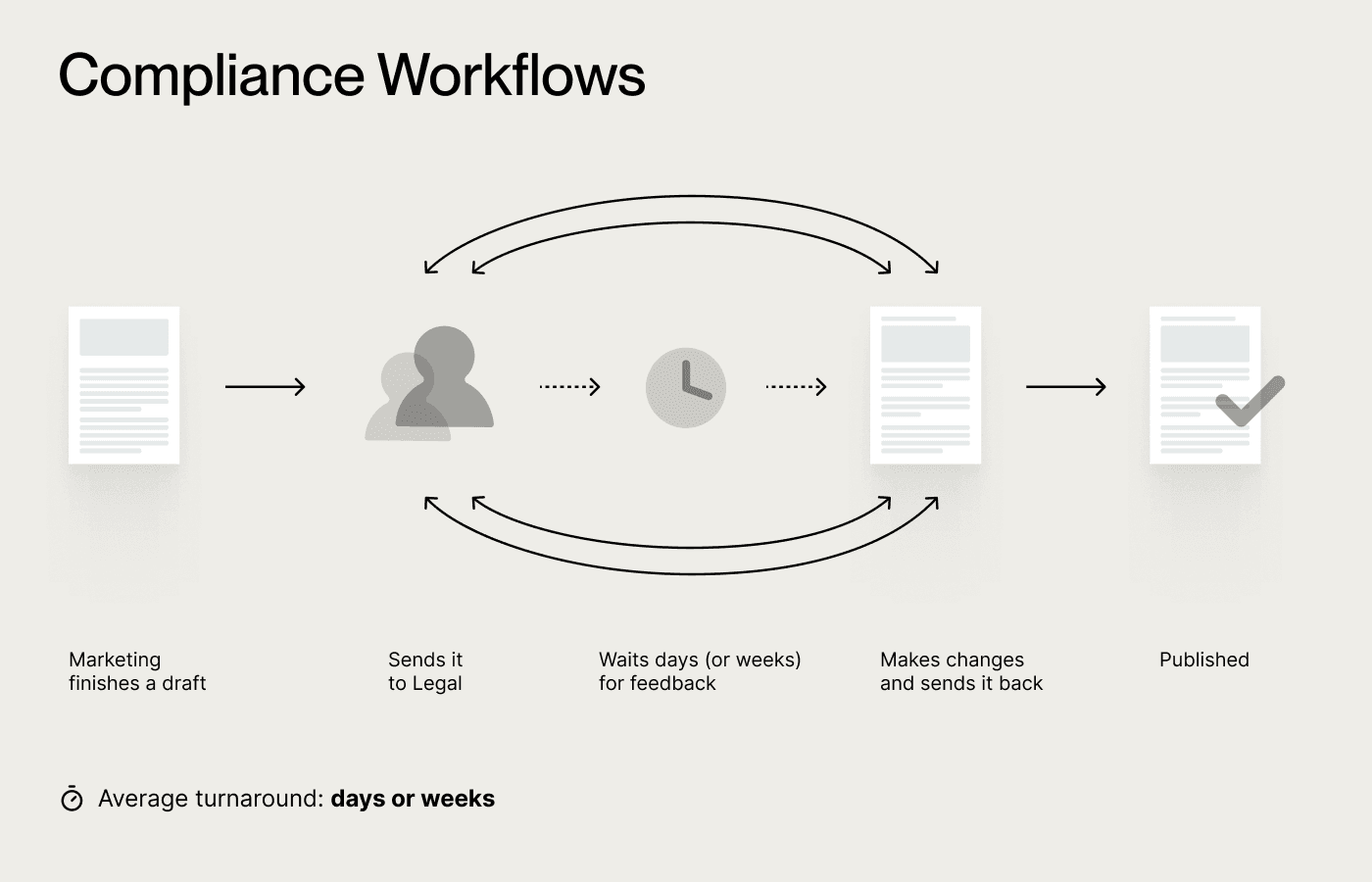
Yet, most compliance workflows still look like this:
Marketing finishes a draft
Sends it to Legal via email or Slack
Waits days (or weeks) for feedback
Makes changes
Sends it back
Repeats
This model breaks down at scale.
Time-to-market slows to a crawl
Legal teams become bottlenecks
Marketers work around the process
Risk quietly increases
Meanwhile, competitors with automated review and monitoring are already live.
Key Financial Services Regulations to Watch in 2026
Regulation | Region | Regulator | What It Means for Marketing & Compliance |
|---|---|---|---|
Consumer Duty | UK | FCA | Every customer-facing communication must demonstrate “good outcomes”, clarity, and fairness across the full lifecycle. |
SEC Marketing Rule (Rule 206(4)-1) | USA | SEC | Strict substantiation of performance claims, testimonials, endorsements, and AI-assisted advice. |
UDAAP | USA | CFPB | Prohibits unfair, deceptive, or abusive acts across digital journeys, disclosures, and customer communications. |
Design & Distribution Obligations (DDO) | Australia | ASIC | Products must only be marketed to their defined Target Market; campaign targeting and messaging must align. |
RG 234 / RG 168 | Australia | ASIC | Financial advertising must be clear, balanced, and include prominent risk disclosures. |
EU AI Act | EU | European Commission | Transparency and governance requirements for AI-driven marketing, personalisation, and automated advice. |
Unfair Commercial Practices Directive (UCPD) | EU | EU Member States | Prohibits misleading actions, omissions, and aggressive marketing practices. |
MAS Guidelines on Fair Dealing | Singapore | MAS | Requires fair, clear, and transparent customer communications across financial products. |
Read about regulatory pressure points to watch out for this year in the US, UK and Australia.
How to Automate Marketing Compliance: A Step-by-Step Guide with Haast
Haast doesn’t sit alongside your compliance process - it becomes the system through which compliance is executed day to day.
At a high level, Haast automates the repeatable work, while keeping legal teams firmly in control of judgement and sign-off. Here’s how it works in practice.

Encode Your Organization’s Risk Tolerance into Haast
Automation only works if the system thinks the way your lawyers do. Haast starts by working directly with your in-house legal and compliance teams to embed:
Internal policies and playbooks
Regulatory interpretations
Risk tolerances by product, channel, and region
Contextual documentation
This isn’t a generic rules engine. It’s your organization’s compliance logic, captured in a system that can apply it consistently. Haast delivers compliance feedback that mirrors how your legal team thinks - consistently, at scale.

Upload Marketing Content for Automated Review
Marketing teams upload drafts into Haast - whether that’s a website page, campaign copy, social post, brochure or video campaign.
Haast immediately reviews the content against your pre-defined compliance rule sets.
Instead of waiting days for legal feedback, marketers get structured compliance guidance instantly.

Iterate Until the Content Passes Compliance Checks
When issues are flagged, Haast doesn’t just say “this is non-compliant”. It explains:
Why it’s flagged something as a risk
How to fix it (based on your lawyer’s previous feedback) to pass your compliance checks
This enables marketing teams to iterate quickly, re-running checks until the content has passed all relevant rules. By the time Legal sees it, content should be 95% compliant.

Legal Receives a Final Review - with Full Context
Once content passes Haast’s checks, it’s sent to Legal for final approval. Crucially, Legal is able to see the full audit trail, including the compliance feedback Haast provided and versioning.
Legal can then:
Approve with confidence
Provide feedback to further refine Haast’s analysis
Adjust policies or tolerances over time
This creates a value loop: the system gets smarter, and Legal’s workload decreases.

Monitor Live Content for Compliance Drift
Compliance doesn’t stop at approval. Haast continuously monitors live content and channels across:
Websites
Social media
Partner and distributor sites
If something drifts out of compliance - due to regulatory change, product updates, or expired offers - the relevant teams are alerted immediately. No more relying on someone to “notice” an issue weeks later - or worse, drifts going completely unnoticed.

Scan for Regulatory Changes (BETA)
Haast also scans the regulatory landscape on your behalf. Based on your organization’s risk profile, it:
Monitors relevant regulatory updates
Assesses where obligations may change
Identifies gaps between new requirements and existing policies or content
Alerts the right stakeholders when action is needed
This turns compliance from a reactive scramble into a proactive, future-proofed system.
Case Study: How Zurich Cut Compliance Review Times by 50%
To see the impact of this automation in the real world, we look at Zurich, one of the world’s leading insurance providers.
The Challenge: Manual Bottlenecks
Before Haast, Zurich’s compliance process was entirely manual. Teams had to check every Product Disclosure Statement (PDS) and Target Market Determination (TMD) line-by-line. This created significant bottlenecks, with even small changes taking days to finalize.
The Solution: Integrated Automation
Zurich integrated Haast into their drafting and approval workflows. Instead of the constant back-and-forth with Legal, the drafting team now receives instant compliance feedback from Haast.
The Impact: Compliance at Scale
Time Efficiency: Drafting complex documents like TMDs or PDSs now takes half the time.
Visibility: Haast provides a "Live Component" that scans Zurich’s entire digital footprint, surfacing potential risks across websites and social channels in real time.
Scalability: Zurich is now expanding Haast into Call Centre Intelligence, using AI to analyze transcripts and identify vulnerable customers or regulatory issues automatically.
"The biggest impact we see with Haast is when we’re drafting TMD or PDS documents - it’s cutting our time in half, which is amazing, all while staying compliant."

Wessel van Keulen
Ex Head of Regulatory Change, Zurich (ANZ)
Best Marketing Compliance Software for Financial Services
Not all compliance software is built for financial services. Generic “AI checkers” apply blunt rules with no understanding of your organization’s risk appetite. This approach doesn’t scale in a regulated environment where context, judgement, and auditability matter.
The best marketing compliance software for financial services must do three things exceptionally well:
1. Reflect Your Legal Team’s Judgement - Not Generic Rules
Haast is built to mirror how your in-house legal and compliance teams actually think. Your lawyers work directly with Haast to embed:
Internal policies and playbooks
Regulatory interpretations by jurisdiction
Risk tolerances by product, channel, and audience
The result is automated compliance feedback that reflects your organization’s standards - not a lowest-common-denominator model.
2. Automate Review Before Content Reaches Legal
Most compliance risk is created long before Legal ever sees a draft.
Haast enables marketing teams to run compliance checks themselves, during drafting, using the same logic Legal would apply later. This removes avoidable issues early, dramatically reducing back-and-forth and review cycles.
Legal stays in control of final sign-off - but they review content that’s already been pressure-tested.
3. Monitor Live Content and Regulatory Change Continuously
Approval is no longer the finish line. Haast continuously monitors:
Live websites and landing pages
Social media and paid campaigns
Partner and distributor content
If something drifts out of compliance - due to regulatory change, product updates, or expired disclosures - teams are alerted immediately.
On top of that, Haast can perform intelligent horizon scanning: tracking regulatory updates relevant to your organization, assessing impact, and flagging where policies, rules, or content need to change.
This turns compliance from a reactive function into a proactive system.
Why Haast Is the Best Fit for Financial Services Businesses
Haast is purpose-built for highly regulated industries where:
Marketing output is high-volume and fast-moving
Legal teams are stretched thin
Auditability and defensibility are non-negotiable
By combining automated pre-live review, continuous monitoring, and regulatory horizon scanning, Haast enables financial services firms to move faster - without increasing risk.
That’s why organizations like Zurich rely on Haast to modernise marketing compliance at scale.
Key Takeaways: The Future of Compliance is Proactive
In financial services, waiting for a human to manually spot every compliance issue is no longer viable.
The firms pulling ahead are:
Leveraging technology to fully automate the low-risk marketing compliance checks
Monitoring live content continuously with always-on compliance tools
Letting humans focus on judgement, not checking
Team Haast